Breast Conservation Surgery with MICAP Flap Reconstruction for Breast Cancer

Breast Conservation Surgery with MICAP Flap Reconstruction in Advanced Breast Cancer
Introduction
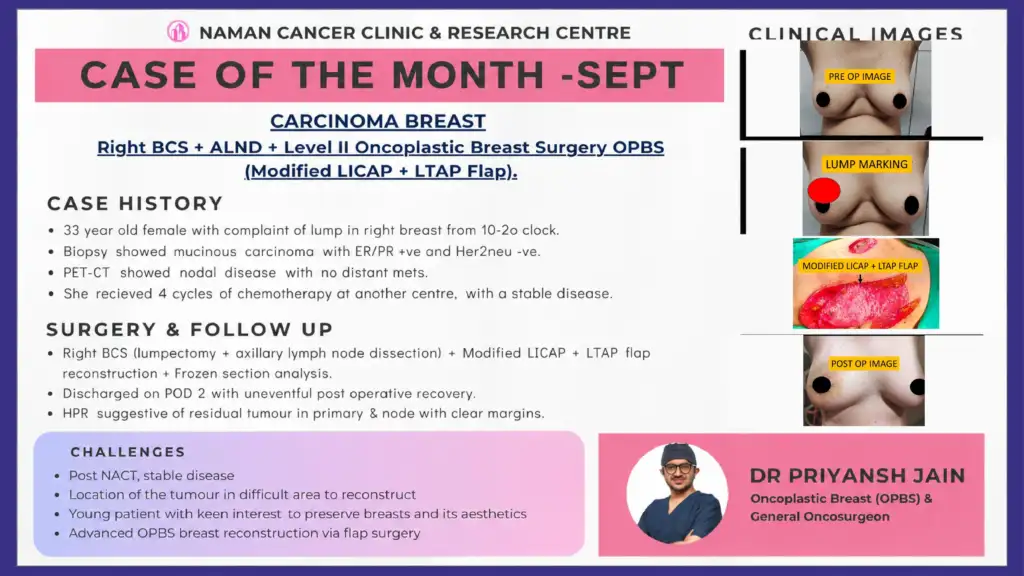
Breast Conservation Surgery with MICAP Flap Reconstruction is an advanced oncoplastic breast surgery technique used to remove breast cancer while preserving the natural breast shape and cosmetic appearance.
Breast cancer is the most common cancer affecting women worldwide. With advances in cancer surgery and reconstruction techniques, many patients can now preserve their breast shape and appearance without compromising cancer treatment outcomes.
At Naman Cancer Clinic & Research Centre, we recently managed a challenging case of locally advanced left breast cancer using Breast Conservation Surgery (BCS) combined with MICAP flap reconstruction after neoadjuvant chemotherapy.
This case highlights the importance of personalized multidisciplinary cancer care and modern oncoplastic breast surgery techniques.
Case Summary
A 44-year-old female presented with complaints of a lump in the left breast. Clinical evaluation and biopsy confirmed ductal carcinoma of the breast.
Immunohistochemistry showed:
- ER/PR Positive
- HER2neu Negative
PET-CT scan demonstrated bulky axillary nodal disease without evidence of distant metastasis.
Considering the locally advanced nature of the disease, the patient was started on neoadjuvant chemotherapy (NACT). She received 4 cycles of chemotherapy through a chemoport before surgery.
Challenges in This Case
This case involved several unique surgical and oncological challenges.
1. Non-Palpable Tumour after Chemotherapy
Following chemotherapy, the tumour became clinically non-palpable, which can make precise localization during surgery difficult.
2. No Clip Placement
Ideally, clips are placed inside the tumour before chemotherapy to help identify the original tumour location later during surgery. However, due to financial constraints, clip placement could not be performed.
To overcome this challenge, careful clinical marking of the lump was performed before starting chemotherapy.
3. Requirement of Breast Reconstruction
The patient required breast conservation along with reconstruction to maintain breast symmetry and cosmetic appearance after tumour removal.
Surgical Procedure Performed
The patient underwent:
- Left Breast Conservation Surgery (Lumpectomy)
- Left Axillary Lymph Node Dissection (ALND)
- MICAP Flap Reconstruction
- Frozen Section Analysis
What is MICAP Flap Reconstruction?
MICAP (Medial Intercostal Artery Perforator) flap reconstruction is an advanced oncoplastic breast reconstruction technique that uses nearby tissue and blood supply to reconstruct breast defects after tumour removal.
Advantages of MICAP flap reconstruction include:
- Preservation of breast shape
- Better cosmetic outcomes
- Use of patient’s own tissue
- Avoidance of implants
- Improved psychological confidence after surgery
This technique is especially useful for defects in lower and inner breast regions.
Role of Frozen Section Analysis
During surgery, frozen section analysis was performed to evaluate surgical margins immediately.
This helps ensure:
- Complete tumour removal
- Clear margins
- Reduced chances of repeat surgery
Histopathology and Further Treatment
Final Histopathological Report (HPR) suggested residual tumour with clear margins, indicating successful oncological resection.
Postoperatively:
- The patient completed 4 additional cycles of chemotherapy
- Adjuvant radiation therapy was administered
- She is currently on hormonal therapy along with CDK 4/6 inhibitors
This multidisciplinary treatment approach significantly improves long-term disease control and survival outcomes in hormone-positive breast cancer.
Recovery and Outcome
The patient recovered well and was discharged on Postoperative Day 2.
Follow-up photographs at 9 months demonstrated:
- Good breast symmetry
- Satisfactory cosmetic outcome
- Well-healed surgical scars
- No major postoperative deformity
This case highlights how modern oncoplastic breast surgery can achieve both excellent cancer control and aesthetic preservation.
Understanding Breast Conservation Surgery (BCS)
Breast Conservation Surgery, also called lumpectomy, involves removal of the tumour with a rim of normal tissue while preserving the remaining breast.
Multiple studies have shown that:
- Breast conservation combined with radiation provides survival outcomes comparable to mastectomy in selected patients.
- Cosmetic and psychological outcomes are often better with breast preservation.
Not every patient is suitable for BCS, and treatment decisions should always be individualized.
Key Learning Points
- Neoadjuvant chemotherapy can shrink breast tumours and allow breast preservation.
- Proper tumour localization before chemotherapy is extremely important.
- Oncoplastic reconstruction techniques improve cosmetic outcomes after cancer surgery.
- MICAP flap reconstruction is a valuable option in selected breast conservation cases.
- Multidisciplinary breast cancer care leads to optimal oncological and aesthetic outcomes.
Conclusion
Modern breast cancer treatment is no longer limited to tumour removal alone. Today, the goal is to achieve complete cancer clearance while preserving body image, confidence, and quality of life.
This case demonstrates how advanced oncoplastic techniques such as MICAP flap reconstruction can help patients undergo successful breast conservation surgery with excellent cosmetic and oncological outcomes.
At Naman Cancer Clinic & Research Centre, we remain committed to providing evidence-based, patient-centered breast cancer care using advanced surgical and reconstructive techniques.
Also read,
Dr Priyansh Jain
Surgical Oncologist (Oncosurgeon)
Naman Cancer Clinic & Research Centre, Surat
Also read: Bilateral VATS Surgery for Thymoma: Advanced Minimally Invasive Mediastinal Mass Removal
Also read: Advanced Oral Cancer Surgery with ALT Free Flap Reconstruction