Advanced Oral Cancer Surgery with ALT Free Flap Reconstruction

Advanced Oral Cancer Surgery for Complex Oral Tumours
Introduction
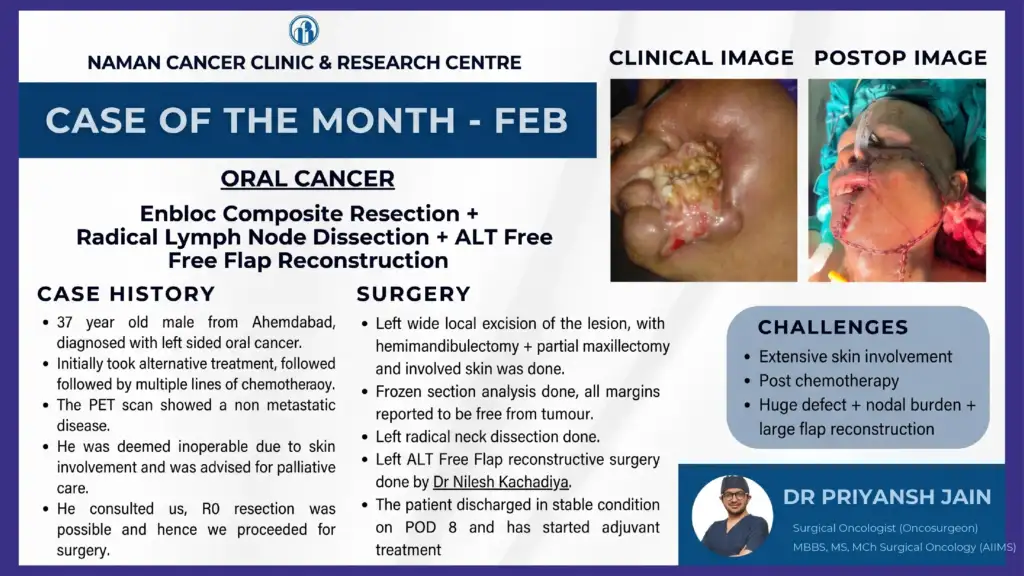
Advanced Oral Cancer Surgery plays an important role in treating complex oral tumours that involve the jaw, facial skin, lymph nodes, and surrounding tissues. At Naman Cancer Clinic & Research Centre, Dr Priyansh Jain successfully managed a challenging oral cancer case using ALT Free Flap Reconstruction, helping achieve complete tumour removal and improved functional recovery.
Oral cancer is one of the most common cancers in India, often presenting in advanced stages due to delayed diagnosis, tobacco use, or initial alternative treatments. Management of advanced oral cancer requires aggressive surgical planning, multidisciplinary coordination, and complex reconstruction techniques to achieve both cancer control and functional rehabilitation.
At Naman Cancer Clinic & Research Centre, we recently managed a challenging case of advanced left-sided oral cancer that had previously been considered inoperable. With careful evaluation and surgical planning, successful complete tumour removal (R0 resection) and reconstruction were achieved.
Case Summary
A 37-year-old male from Ahmedabad was diagnosed with advanced left-sided oral cancer.
Before consulting us:
- The patient had initially undergone alternative treatment
- He later received multiple lines of chemotherapy
- He was eventually considered inoperable elsewhere because of extensive skin involvement
- Palliative care had been advised
Despite the complexity of the disease, further evaluation at our centre suggested that complete tumour removal with negative margins (R0 resection) might still be achievable.
PET scan evaluation confirmed non-metastatic disease, making curative intent surgery a possible option.
Challenges in This Case
This case was particularly demanding because of several factors.
1. Extensive Skin Involvement
The tumour had infiltrated surrounding facial skin, increasing the complexity of resection and reconstruction.
2. Post-Chemotherapy Changes
Previous chemotherapy often causes tissue fibrosis and altered anatomy, making surgical dissection more difficult.
3. Large Composite Defect
The surgery required removal of:
- Oral cavity tumour
- Involved mandible
- Part of maxilla
- Skin and soft tissue
- Extensive nodal disease
This resulted in a massive composite defect requiring advanced reconstructive surgery.
Surgical Procedure Performed
The patient underwent:
- Enbloc Composite Resection
- Radical Neck Lymph Node Dissection
- ALT (Anterolateral Thigh) Free Flap Reconstruction
Extent of Resection
The surgical procedure included:
- Left wide local excision of the oral lesion
- Hemimandibulectomy
- Partial maxillectomy
- Resection of involved skin
The goal was complete tumour clearance while preserving as much function as possible.
Role of Frozen Section Analysis
Intraoperative frozen section analysis was performed to assess all surgical margins during the procedure.
All margins were reported free from tumour, confirming successful R0 resection — one of the most important predictors of long-term disease control in oral cancer surgery.
Radical Neck Dissection
A left radical neck dissection was also performed to remove involved cervical lymph nodes.
Lymph node clearance is critical in advanced oral cancers because nodal disease significantly impacts prognosis and recurrence risk.
ALT Free Flap Reconstruction
After removal of the tumour and surrounding structures, the patient was left with a large facial and oral defect.
Reconstruction was performed using an:
ALT (Anterolateral Thigh) Free Flap
This microsurgical reconstructive technique involves transferring tissue from the thigh along with its blood vessels to reconstruct the oral and facial defect.
Advantages of ALT Free Flap Reconstruction
- Large volume tissue coverage
- Good vascularity
- Improved wound healing
- Restoration of facial contour
- Better speech and swallowing rehabilitation
- Improved cosmetic outcomes
The reconstructive procedure was performed by Dr Nilesh Kachadiya.
Postoperative Recovery
The patient recovered well after surgery and was discharged in stable condition on Postoperative Day 8.
He has subsequently started adjuvant treatment as part of comprehensive multimodality cancer care.
This case demonstrates that even patients initially labelled “inoperable” may benefit from reassessment at specialized cancer centres with expertise in advanced surgical oncology and reconstruction.
Understanding Advanced Oral Cancer
Advanced oral cancers may involve:
- Jaw bones
- Skin
- Tongue
- Cheek
- Neck lymph nodes
Common symptoms include:
- Non-healing mouth ulcer
- Facial swelling
- Difficulty swallowing
- Pain
- Bleeding
- Loose teeth
- Neck swelling
Early diagnosis significantly improves outcomes and reduces the need for extensive surgery.
Key Learning Points
- Advanced oral cancers should be evaluated at specialized centres before declaring them inoperable.
- R0 resection remains the cornerstone of curative treatment.
- Frozen section analysis improves surgical precision and margin clearance.
- ALT free flap reconstruction plays a major role in functional and cosmetic rehabilitation.
- Multidisciplinary management is essential in complex head and neck cancer cases.
Conclusion
This case highlights the importance of aggressive but carefully planned surgical management in advanced oral cancer. Even complex tumours with extensive skin and nodal involvement may still be treated with curative intent when evaluated appropriately.
Modern reconstructive techniques such as ALT free flap surgery now allow surgeons to restore both form and function after extensive cancer resections, significantly improving patient outcomes and quality of life.
At Naman Cancer Clinic & Research Centre, we remain committed to delivering advanced, evidence-based cancer care with a focus on oncological safety, reconstruction, and rehabilitation.
Also read,
Dr Priyansh Jain
Surgical Oncologist (Oncosurgeon)
Naman Cancer Clinic & Research Centre, Surat
Also read: Bilateral VATS Surgery for Thymoma: Advanced Minimally Invasive Mediastinal Mass Removal