Hepatocellular Carcinoma Surgery: 5 Key Liver Cancer Insights
Hepatocellular Carcinoma Surgery in Cirrhotic Liver Patients
Hepatocellular Carcinoma Surgery is one of the most effective treatment options for localized liver cancer, especially in patients with cirrhotic liver disease where careful surgical planning is essential.
A recent “Case of the Month” at Naman Cancer Clinic & Research Centre involved the successful surgical management of a patient diagnosed with Hepatocellular Carcinoma (HCC), the most common primary cancer of the liver.
Introduction
Hepatocellular Carcinoma (HCC) is one of the leading causes of cancer-related deaths worldwide. It commonly develops in patients with chronic liver disease or cirrhosis. Early diagnosis and timely surgical intervention can significantly improve survival and quality of life.
Managing liver cancer becomes even more challenging when the liver is cirrhotic, as preserving adequate healthy liver tissue is essential to avoid liver failure after surgery.
Case Summary
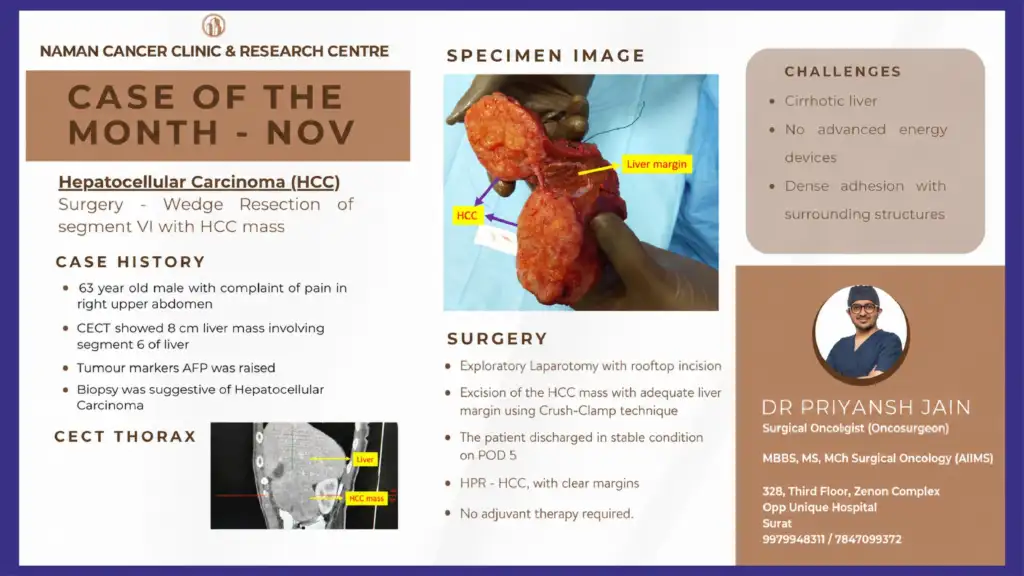
A 63-year-old male patient presented with complaints of pain in the right upper abdomen. Clinical evaluation and imaging were performed to determine the cause of his symptoms.
Contrast Enhanced CT (CECT) scan revealed an approximately 8 cm mass involving Segment VI of the liver. Blood investigations showed elevated Alpha-Fetoprotein (AFP) levels, which is a commonly raised tumour marker in patients with HCC.
A biopsy confirmed the diagnosis of Hepatocellular Carcinoma.
Understanding Hepatocellular Carcinoma (HCC)
HCC is the most common type of primary liver cancer. It usually develops in patients with:
- Liver cirrhosis
- Chronic Hepatitis B or C infection
- Alcohol-related liver disease
- Fatty liver disease (NAFLD/NASH)
Common symptoms may include:
- Pain or heaviness in the right upper abdomen
- Loss of appetite
- Weight loss
- Weakness or fatigue
- Abdominal swelling
However, some liver cancers may remain silent until they become large enough to produce symptoms.
Surgical Challenges
Liver surgery is considered one of the more technically demanding oncological procedures. In this patient, several challenges made the surgery particularly complex:
1. Cirrhotic Liver
A cirrhotic liver is fragile and has reduced functional reserve. Surgery in such patients carries a higher risk of bleeding and postoperative liver dysfunction.
2. Dense Adhesions
The tumour had dense adhesions with surrounding structures, making dissection technically difficult.
3. Limited Resources
The surgery was performed without advanced energy devices, requiring meticulous surgical technique and careful haemostasis throughout the procedure.
Despite these challenges, successful tumour removal was achieved safely.
Surgical Procedure
The patient underwent an Exploratory Laparotomy with rooftop incision for adequate exposure of the liver.
A wedge resection of Segment VI containing the HCC mass was performed with adequate liver margins. The tumour was excised using the Crush-Clamp technique, a well-established liver transection method that allows controlled and safe liver tissue dissection while minimizing bleeding.
The primary goals of surgery were:
- Complete tumour removal
- Preservation of maximum healthy liver tissue
- Achieving clear margins
- Maintaining postoperative liver function
Histopathology Findings
Final Histopathological Report (HPR) confirmed:
- Hepatocellular Carcinoma (HCC)
- Clear surgical margins
Clear margins indicate that no tumour cells were seen at the cut edges of the specimen, which significantly reduces the risk of local recurrence.
As the tumour was completely removed, no adjuvant therapy was required.
Postoperative Recovery
The patient recovered well after surgery and was discharged in stable condition on Postoperative Day 5.
This case highlights how carefully planned liver surgery can achieve excellent outcomes even in patients with cirrhotic liver disease.
Key Learning Points
- Hepatocellular Carcinoma is the most common primary liver cancer.
- Cirrhosis significantly increases the complexity of liver surgery.
- AFP is an important tumour marker used in HCC evaluation.
- Complete surgical excision with clear margins remains one of the best curative options for localized HCC.
- Proper surgical planning and meticulous technique are essential for successful outcomes.
Conclusion
Liver cancer surgery in cirrhotic patients requires experience, precision, and sound oncological judgment. This case demonstrates that even large liver tumours can be successfully managed with careful surgical planning and execution.
At Naman Cancer Clinic & Research Centre, advanced cancer care is delivered with a focus on evidence-based treatment, patient safety, and optimal long-term outcomes.
Also read,
Dr Priyansh Jain
Surgical Oncologist (Oncosurgeon)
Naman Cancer Clinic & Research Centre, Surat
Also read: Bilateral VATS Surgery for Thymoma: Advanced Minimally Invasive Mediastinal Mass Removal
Also read: Breast Conservation Surgery with MICAP Flap Reconstruction for Breast Cancer