Advanced Oncoplastic Breast Surgery with LICAP & LTAP Flaps

Benefits of Breast Conservation Surgery in Breast Cancer
Introduction
Advanced Oncoplastic Breast Surgery plays an important role in modern breast cancer treatment by combining tumour removal with aesthetic breast reconstruction.
Modern breast cancer treatment is no longer focused only on cancer removal. Today, equal importance is given to preserving breast appearance, body image, and quality of life while ensuring complete oncological safety.
At Naman Cancer Clinic & Research Centre, we recently managed a challenging case of right breast cancer in a young woman using advanced Oncoplastic Breast Surgery (OPBS) techniques involving Breast Conservation Surgery (BCS) with Modified LICAP + LTAP flap reconstruction.
This case highlights how modern reconstructive techniques can help preserve the breast even in difficult tumour locations.
Case Summary
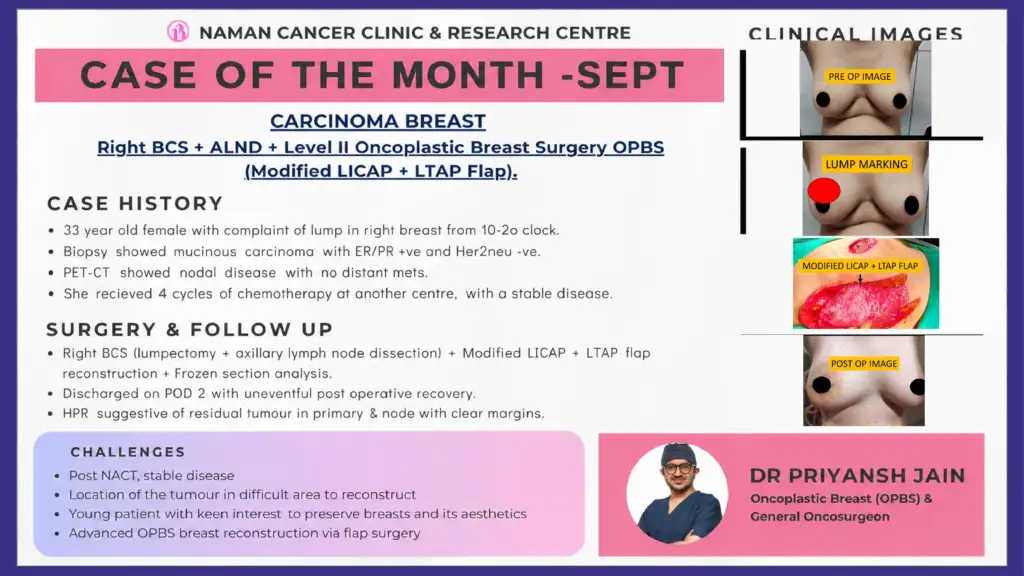
A 33-year-old female presented with a lump in the right breast located between the 10–2 o’clock position.
Biopsy confirmed:
- Mucinous carcinoma of the breast
- ER/PR Positive
- HER2neu Negative
PET-CT scan demonstrated axillary nodal disease without distant metastasis.
The patient had already received 4 cycles of chemotherapy at another centre and showed stable disease after treatment.
Challenges in This Case
This was a particularly complex breast conservation case due to multiple factors.
1. Young Patient with Strong Desire for Breast Preservation
As a young woman, preserving breast shape, symmetry, and aesthetics was an important priority for the patient.
2. Difficult Tumour Location
The tumour was located in a surgically challenging area of the breast where standard lumpectomy could have resulted in significant deformity or asymmetry.
3. Post-Neoadjuvant Chemotherapy Disease
Despite chemotherapy, the disease remained stable, requiring careful surgical planning to achieve complete tumour clearance while preserving cosmetic outcomes.
4. Requirement of Advanced Reconstruction
Large tissue defects following tumour excision required advanced flap reconstruction techniques to maintain breast contour.
Surgical Procedure Performed
The patient underwent:
- Right Breast Conservation Surgery (Lumpectomy)
- Axillary Lymph Node Dissection (ALND)
- Level II Oncoplastic Breast Surgery (OPBS)
- Modified LICAP + LTAP Flap Reconstruction
- Frozen Section Analysis
Understanding Oncoplastic Breast Surgery (OPBS)
Oncoplastic Breast Surgery combines:
- Cancer surgery principles
with - Plastic and reconstructive surgery techniques
The goal is to:
- Remove the tumour completely
- Preserve breast shape and symmetry
- Minimize deformity after surgery
- Improve long-term cosmetic outcomes
OPBS allows many patients who would otherwise require mastectomy to safely undergo breast conservation.
What are LICAP and LTAP Flaps?
LICAP Flap
LICAP stands for:
Lateral Intercostal Artery Perforator Flap
This technique uses nearby skin and fatty tissue supplied by lateral chest wall perforator vessels to reconstruct breast defects.
LTAP Flap
LTAP stands for:
Lateral Thoracic Artery Perforator Flap
This flap provides additional soft tissue coverage and vascular support for breast reconstruction.
By combining Modified LICAP and LTAP flaps, adequate tissue volume and contour restoration were achieved in this patient.
Role of Frozen Section Analysis
Frozen section analysis was performed during surgery to assess:
- Surgical margins
- Adequacy of tumour removal
This helps reduce the need for repeat surgery and ensures oncological safety during breast conservation procedures.
Histopathology and Recovery
Final Histopathological Report (HPR) showed:
- Residual tumour in the primary breast lesion and lymph node
- Clear surgical margins
The patient had an uneventful postoperative recovery and was discharged on Postoperative Day 2.
Postoperative images demonstrated:
- Good breast contour
- Preserved symmetry
- Acceptable cosmetic outcome
- Well-healed surgical site
Advantages of Advanced Oncoplastic Reconstruction
Advanced flap-based breast reconstruction offers several benefits:
- Better cosmetic outcomes
- Preservation of breast volume
- Reduced breast deformity
- Improved psychological confidence
- Enhanced quality of life
These techniques are especially useful in:
- Young patients
- Large tumours
- Difficult tumour locations
- Patients strongly desiring breast preservation
Key Learning Points
- Breast conservation is possible even in difficult tumour locations with advanced OPBS techniques.
- Young patients benefit significantly from aesthetic preservation.
- LICAP and LTAP flaps are valuable reconstructive options after large lumpectomy defects.
- Frozen section analysis improves oncological safety during BCS.
- Modern breast cancer care must balance cancer control with cosmetic outcomes and patient quality of life.
Conclusion
Advanced Oncoplastic Breast Surgery is transforming breast cancer treatment by combining safe cancer surgery with sophisticated reconstruction techniques. This case demonstrates how breast conservation with Modified LICAP + LTAP flap reconstruction can achieve excellent oncological clearance along with aesthetically satisfying results.
At Naman Cancer Clinic & Research Centre, we remain committed to delivering personalized, evidence-based breast cancer care using advanced oncoplastic surgical techniques tailored to each patient’s needs.
Also read,
Dr Priyansh Jain
Surgical Oncologist (Oncosurgeon)
Naman Cancer Clinic & Research Centre, Surat
Also read: Hepatocellular Carcinoma Surgery: 5 Key Liver Cancer Insights
Also read: Breast Conservation Surgery with MICAP Flap Reconstruction for Breast Cancer