Colorectal Cancer Surgery: Advanced Treatment for Colon & Rectal Cancer
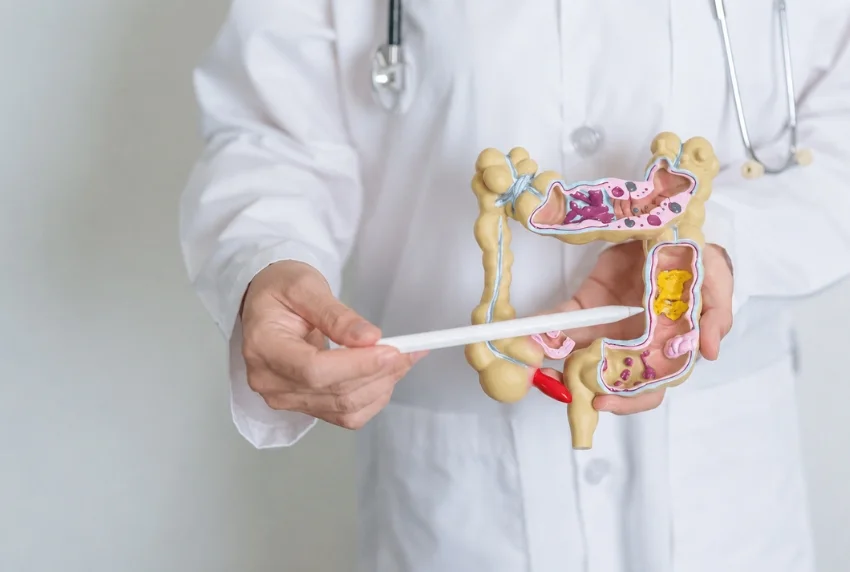
Colorectal Cancer Surgery for Colon Tumours
Introduction
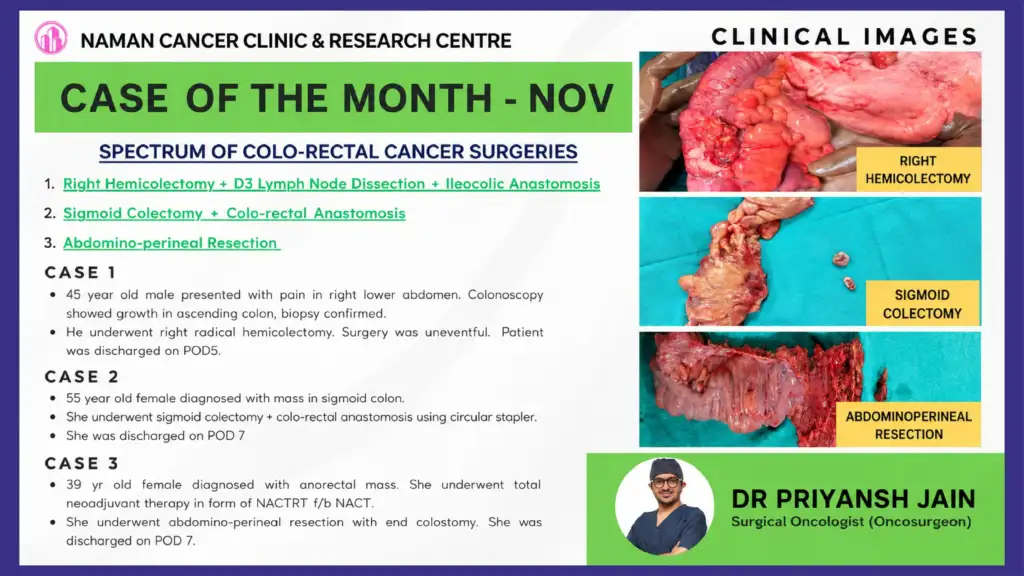
Colorectal cancer surgery plays a crucial role in the treatment of colon and rectal cancer, helping achieve complete tumour removal and improved long-term outcomes.
Colorectal cancer is among the most common gastrointestinal cancers worldwide. Depending on the location and stage of the tumour, treatment may involve different surgical procedures aimed at complete tumour removal while preserving bowel function whenever possible.
At Naman Cancer Clinic & Research Centre, we routinely perform a wide spectrum of colorectal cancer surgeries ranging from colon resections to advanced rectal cancer procedures. This “Case of the Month” highlights three different colorectal cancer cases managed with individualized surgical approaches.
Understanding Colorectal Cancer Surgery
The colon and rectum form the lower part of the digestive tract. Cancers can arise in different segments, and surgical treatment varies according to:
- Tumour location
- Extent of disease
- Lymph node involvement
- Response to chemotherapy or radiation
- Patient fitness and bowel function
The primary goal of surgery is:
- Complete tumour removal (R0 resection)
- Adequate lymph node dissection
- Restoration of bowel continuity whenever feasible
Case 1: Ascending Colon Cancer
Clinical Presentation
A 45-year-old male presented with pain in the right lower abdomen.
Further evaluation with colonoscopy revealed a growth in the ascending colon, and biopsy confirmed colon cancer.
Surgical Procedure Performed
The patient underwent:
Right Radical Hemicolectomy
with
D3 Lymph Node Dissection
and
Ileocolic Anastomosis
What is Right Hemicolectomy?
Right hemicolectomy involves removal of:
- Ascending colon
- Cecum
- Terminal ileum (partially)
- Associated lymphatic drainage
D3 Lymph Node Dissection
D3 dissection involves extensive lymph node clearance along major vascular pedicles, which improves oncological clearance and staging accuracy.
Ileocolic Anastomosis
After tumour removal, the small intestine was connected to the remaining colon to restore bowel continuity.
Outcome
The surgery was uneventful, and the patient recovered well and was discharged on Postoperative Day 5.
Case 2: Sigmoid Colon Cancer
Clinical Presentation
A 55-year-old female was diagnosed with a mass involving the sigmoid colon.
Surgical Procedure Performed
The patient underwent:
Sigmoid Colectomy
with
Colo-rectal Anastomosis
A circular stapler was used for reconstruction after tumour removal.
Understanding Sigmoid Colectomy
Sigmoid colectomy involves removal of the diseased sigmoid colon segment along with associated lymph nodes.
After resection:
- The remaining colon is connected to the rectum
- Bowel continuity is restored
- Permanent stoma is often avoided in selected patients
Outcome
The postoperative recovery was smooth, and the patient was discharged on Postoperative Day 7.
Case 3: Advanced Anorectal Cancer
Clinical Presentation
A 39-year-old female was diagnosed with an anorectal mass.
Given the locally advanced disease, she first received:
- Neoadjuvant Chemoradiotherapy (NACTRT)
followed by - Neoadjuvant Chemotherapy (NACT)
This multimodality approach helps:
- Reduce tumour size
- Improve resectability
- Lower recurrence rates
Surgical Procedure Performed
The patient underwent:
Abdomino-Perineal Resection (APR)
with
End Colostomy
What is Abdomino-Perineal Resection?
APR is performed for low rectal or anorectal cancers involving or close to the anal sphincter.
The surgery involves removal of:
- Rectum
- Anal canal
- Surrounding tissues
Since bowel continuity cannot be restored safely, a permanent end colostomy is created.
Outcome
The patient recovered well after surgery and was discharged on Postoperative Day 7.
Importance of Personalized Colorectal Cancer Care
These three cases highlight how colorectal cancer surgery is highly individualized. Treatment planning depends on:
- Tumour location
- Stage of disease
- Patient factors
- Response to neoadjuvant therapy
Modern colorectal cancer management often combines:
- Surgery
- Chemotherapy
- Radiation therapy
- Advanced reconstruction techniques
to achieve optimal long-term outcomes.
Key Learning Points
- Colorectal cancer treatment varies according to tumour location and stage.
- Adequate lymph node dissection is essential for proper cancer surgery.
- Bowel continuity can often be restored using safe anastomotic techniques.
- Advanced rectal cancers may require multimodality treatment before surgery.
- Personalized surgical planning improves oncological and functional outcomes.
Conclusion
Colorectal cancer surgery encompasses a wide range of procedures, from segmental colon resections to complex pelvic surgeries. Careful surgical planning, multidisciplinary management, and adherence to oncological principles are essential for achieving good outcomes.
At Naman Cancer Clinic & Research Centre, we continue to provide comprehensive colorectal cancer care using evidence-based surgical techniques tailored to each patient’s condition and needs.
Also read,
Dr Priyansh Jain
Surgical Oncologist (Oncosurgeon)
Naman Cancer Clinic & Research Centre, Surat
Also read: Hepatocellular Carcinoma Surgery: 5 Key Liver Cancer Insights
Also read: Breast Conservation Surgery with MICAP Flap Reconstruction for Breast Cancer