
Breast Cancer Case Study: Breast-Conserving Surgery with AICAP Flap Reconstruction
A Clinical Case of Right Breast-Conserving Surgery, Sentinel Lymph Node Biopsy and Level II Oncoplastic Reconstruction
Explore the clinical journey of a 71-year-old patient who underwent right breast-conserving surgery with sentinel lymph node biopsy and AICAP flap reconstruction, followed by postoperative care and adjuvant chemotherapy.
Introduction
This Breast Cancer Case Study describes the diagnosis and surgical management of a 71-year-old woman who presented with a right breast lump. Investigations identified invasive breast carcinoma that was ER/PR positive and HER2/neu negative. She underwent right breast-conserving surgery (BCS), sentinel lymph node biopsy (SLNB) and Level II oncoplastic breast surgery using an AICAP flap for reconstruction. This case highlights the role of an individualised surgical approach in breast cancer care.
Case of the Month – November: Right Breast Cancer
Patient: 71-year-old female
Presenting concern: Lump in the right breast for three months
Imaging: Sonomammography showed a BI-RADS IV C mass lesion
Biopsy: Foci of invasive carcinoma
Receptor status: ER/PR positive, HER2 negative
Distant disease assessment: CECT showed no evidence of distant metastasis
The patient underwent right breast-conserving surgery with sentinel lymph node biopsy and Level II oncoplastic breast reconstruction using an AICAP flap.
Patient History and Diagnostic Findings
A 71-year-old female patient presented with a history of a lump in her right breast that had been present for approximately three months.
The diagnostic assessment included breast imaging, biopsy and further evaluation to understand the nature of the lesion and plan the appropriate surgical approach.
1. Sonomammography Findings
Sonomammography identified a mass lesion classified as BI-RADS IV C.
This imaging classification indicated a suspicious finding requiring tissue diagnosis and further clinical assessment.
2. Biopsy and Receptor Status
The biopsy showed foci of invasive carcinoma.
The reported receptor findings were:
- ER: Positive
- PR: Positive
- HER2/neu: Negative
These findings form part of the information used by the treating oncology team when considering an individual patient’s treatment plan.
3. CECT Assessment
CECT scan findings showed no evidence of distant metastasis.
The imaging and biopsy findings were considered as part of the overall clinical assessment before surgery.
Surgical Approach: Right Breast-Conserving Surgery and SLNB
The patient underwent a planned surgical procedure comprising:
- Right breast-conserving surgery (BCS), including lumpectomy.
- Sentinel lymph node biopsy (SLNB).
- Level II oncoplastic breast surgery.
- AICAP flap reconstruction.
- Intraoperative frozen section analysis.
The surgical approach was planned with attention to tumour removal, lymph node assessment and breast reconstruction.
What Is Breast-Conserving Surgery?
Breast-conserving surgery is an operation in which the cancerous area is removed while preserving the remaining breast tissue as much as clinically appropriate.
Lumpectomy is a commonly used form of breast-conserving surgery. The exact surgical plan depends on tumour characteristics, breast anatomy, imaging, pathology and the patient’s clinical circumstances.
What Is Sentinel Lymph Node Biopsy?
Sentinel lymph node biopsy is a surgical procedure used to assess selected lymph nodes that are among the first nodes to receive lymphatic drainage from the breast.
These nodes are examined to help determine whether cancer cells have spread to the regional lymph nodes.
In this case, a single sentinel lymph node was reported as positive during intraoperative assessment.
AICAP Flap in Oncoplastic Breast Surgery
AICAP stands for Anterior Intercostal Artery Perforator flap.
It is a perforator-based tissue flap that may be used in selected oncoplastic breast reconstruction procedures. In this case, AICAP flap reconstruction was used as part of the surgical plan following right breast-conserving surgery.
The choice of reconstruction depends on factors such as the location and size of the tumour, the amount of tissue removed, breast anatomy and the patient’s individual requirements.
Surgical Challenges and Breast Aesthetic Considerations
The tumour location presented a reconstructive challenge. The surgical planning needed to consider the risk of a potential bird-beak deformity, which can affect the contour of the breast after tissue removal.
The patient also expressed a strong preference for breast preservation and attention to breast aesthetics.
The key considerations included:
1. Tumour Location and Breast Contour
The location of the tumour required careful planning to address the potential for breast contour changes following lumpectomy.
Oncoplastic techniques were considered as part of the reconstruction strategy.
2. Breast Preservation
The patient had a keen interest in preserving her breast. The selected approach involved breast-conserving surgery with oncoplastic reconstruction, based on the clinical and surgical assessment.
3. Aesthetic Considerations
The surgical plan considered the placement of incisions and reconstruction of the breast contour. The intended goals included a discreet scar where feasible and attention to the appearance of the breast after surgery.
4. Recovery Considerations
The case notes also identify a drain-less surgical approach and earlier return to normal activities as important considerations.
Recovery time and the need for drains depend on the individual operation, healing and clinical assessment. These outcomes cannot be guaranteed for every patient.
Intraoperative Findings and Lymph Node Management
During surgery, intraoperative frozen section analysis was performed.
One sentinel lymph node was found to be positive. According to the supplied case history, completion axillary lymph node dissection (ALND) was not performed, with the decision recorded as being based on Z0011 criteria.
The ACOSOG Z0011 approach is relevant to selected patients with early-stage, clinically node-negative breast cancer who undergo breast-conserving surgery and have one or two positive sentinel lymph nodes, in the appropriate treatment context.
The decision to omit completion ALND is not based on a positive sentinel node alone. Eligibility and other treatment factors must be assessed by the treating multidisciplinary team.
Postoperative Recovery and Histopathology Findings
The patient was discharged on postoperative day 1 (POD 1) without reported complications in the supplied case notes.
The histopathology report (HPR) was suggestive of:
- Tumour and nodal classification: T2N1
- Surgical margins: Clear margins
These findings formed part of the postoperative assessment and subsequent treatment planning.
The reported clear margins indicate that no tumour was identified at the assessed surgical cut edges in the histopathology report. The complete pathology report and clinical context are important when interpreting the findings.
Follow-Up and Adjuvant Chemotherapy
Following surgery and postoperative assessment, the patient was reported to be receiving adjuvant chemotherapy.
Adjuvant treatment is planned after primary surgery according to the patient’s pathology, tumour characteristics, receptor status, lymph node findings and overall treatment recommendations.
The choice and sequence of additional treatment are individualised by the oncology team. Follow-up is important for monitoring recovery, treatment tolerance and ongoing care needs.
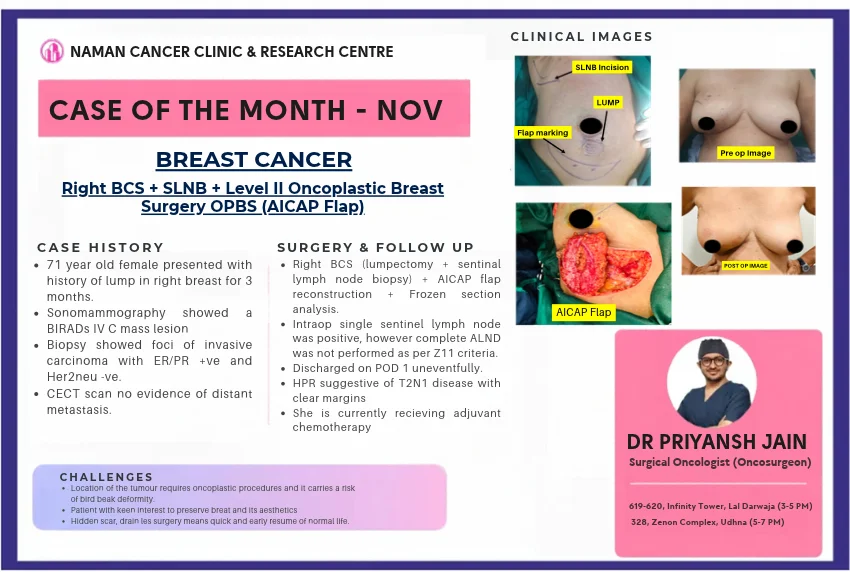
Clinical Images – Breast Cancer Surgery
The clinical image gallery associated with this case includes the following stages and surgical details:
- Preoperative image.
- Sentinel lymph node biopsy incision.
- Flap marking.
- AICAP flap.
- Breast lump.
- Postoperative image.
These photographs document selected aspects of the patient’s clinical and surgical journey at Naman Breast & Cancer Clinic.
Case Summary
This case describes a 71-year-old female patient with right breast invasive carcinoma who underwent breast-conserving surgery, sentinel lymph node biopsy and Level II oncoplastic breast reconstruction using an AICAP flap.
The clinical course included:
- A right breast lump present for three months.
- Sonomammography showing a BI-RADS IV C lesion.
- Biopsy confirming foci of invasive carcinoma.
- ER/PR-positive and HER2-negative receptor status.
- CECT showing no evidence of distant metastasis.
- Right breast-conserving surgery with SLNB and AICAP flap reconstruction.
- One positive sentinel lymph node on intraoperative assessment.
- No completion ALND, as documented in the case notes under Z0011 criteria.
- Discharge on postoperative day 1 without reported complications.
- Histopathology suggestive of T2N1 disease with clear margins.
- Subsequent adjuvant chemotherapy.
The case demonstrates the role of individualised surgical planning in breast cancer care, including consideration of tumour removal, lymph node assessment, breast preservation and reconstructive requirements.
Breast Cancer and Oncoplastic Surgery at Naman Breast & Cancer Clinic, Surat
Breast cancer treatment requires careful evaluation of the diagnosis, tumour characteristics, lymph node status and individual patient preferences.
Dr. Priyansh Jain is an Oncosurgeon with a focus on oncoplastic breast surgery. At Naman Breast & Cancer Clinic, Surat, patients can discuss breast cancer diagnosis, surgical options and treatment planning according to their clinical requirements.
The suitability of breast-conserving surgery and oncoplastic reconstruction varies from patient to patient. A consultation with the treating cancer specialist can help patients understand the available options, expected benefits, limitations and possible risks.
Also read,
Dr Priyansh Jain
Surgical Oncologist (Oncosurgeon) – Naman Cancer Clinic & Research Centre, Surat
Also read: Advanced Oncoplastic Breast Surgery with LICAP & LTAP Flaps
Also read: Case of the Month
Also read: Robotic Cancer Surgery
Also read: National Cancer Institute — Childhood Cancers
Facebook Link: https://www.facebook.com/DrpriyanshOncologist/
Instagram: https://www.instagram.com/dr_priyanshjain/